

Dentistry MMI Interview Course: Dentistry MMI Preparation Course - Dr Admissions

Dentistry MMI Interview Course: Dentistry MMI Preparation Course

Consultant-led preparation for dental MMI, panel and university-specific interviews

The Dr Admissions Dental School Interview Preparation Course is an 11-week online programme for UK dental applicants preparing for MMI and panel interviews. The programme combines live teaching, recordings, dentistry-focused preparation, structured interview frameworks and guided verbal practice, with the first live session free.

The wider Dr Admissions interview programme is led by Dr Afrosa Ahmed, an experienced NHS Medical Consultant, clinical teacher and former medical school interviewer. The emphasis is on learning how to interpret unfamiliar questions, structure individual answers and communicate clearly under pressure rather than memorising model responses.

11-Week Dental Interview Programme

  • Live online teaching + recordings
  • Dental MMI and panel interview preparation
  • Dentistry-specific ethics, communication, motivation and scenarios
  • Dr Ahmed’s InterVIEW™ structured interview method
  • Guided verbal practice and challenging follow-up questions
  • Optional university-specific 1-to-1 dental school mock interview
  • First live session free

Reported 2026 qualifying-cohort result: every student who completed a Dr Admissions Interview Course and at least one Dr Admissions mock interview received at least one medical or dental school offer.*

What Is a Dental School Interview?

A dental school interview allows an admissions team to assess whether an applicant has the personal qualities, judgement and understanding required for a patient-facing healthcare profession. Strong grades and admissions-test results may demonstrate academic potential, but they do not show how a candidate communicates with an anxious patient, reflects on work experience, responds to an ethical dilemma or explains why dentistry is the right career for them.

Interview formats vary between dental schools and can change between admissions cycles. Some universities use Multiple Mini Interviews (MMIs), where applicants rotate through shorter stations. Others use panel interviews, in which several interviewers explore motivation, experiences, professional awareness and reasoning through a longer discussion and follow-up questions.

Dental interviews may assess:

  • Communication and active listening
  • Empathy and patient-centred thinking
  • Motivation for dentistry
  • Reflection on dental work experience
  • Teamwork and leadership
  • Professionalism
  • Ethical reasoning
  • Problem-solving and judgement
  • Dental and healthcare awareness
  • Ability to respond calmly to follow-up questions

Effective preparation therefore needs to go beyond learning “good answers”. Applicants need to understand what a question is assessing, select relevant evidence from their own experience and communicate it naturally when the wording or follow-up changes.

What Do Students Receive on the 11-Week Programme?

Parents and applicants should be able to see exactly what they are booking. The programme is designed as sustained preparation rather than a one-off question bank or isolated mock interview.

  • 11 weeks of structured online interview teaching
  • Live sessions with access to recordings
  • Dental MMI and panel interview preparation
  • Interview frameworks using the InterVIEW™ Method
  • Motivation for dentistry and dental work-experience reflection
  • Ethics, communication, professionalism and patient-centred scenarios
  • Dental hot topics, NHS dentistry and healthcare awareness
  • Role-play, verbal practice and difficult follow-up questions
  • Preparation for unfamiliar questions and scenario-based wording
  • Optional university-specific 1-to-1 dental school mock interview with personalised feedback
  • First live session free

What Does Our Dental School Interview Preparation Course Cover?

The course provides broad dental interview preparation across themes that can arise in both MMI and panel formats. It is deliberately wider than a dentistry MMI question bank: students work on interview technique, dental motivation, work-experience reflection, communication, ethics, professionalism and performance under pressure.

Dental Interview Fundamentals

Students learn how to recognise different interview formats, identify what a question is testing and organise answers efficiently. Preparation includes interview etiquette, timing, body language, answer structure, handling unexpected wording and recovering when an answer has not gone to plan.

A central principle is adaptability. A candidate who understands how to approach a question can respond when the interviewer changes direction; a candidate relying on a memorised script often cannot.

Motivation for Dentistry

“Why dentistry?” is rarely just a request for a polished speech. Interviewers may probe how the applicant reached the decision, whether they understand the profession and whether their experiences support the claims they make. Students prepare to discuss why dentistry appeals to them, why they have chosen it over other healthcare careers, the qualities required of a dentist and why a particular dental school suits them.

The aim is to develop an individual, evidenced explanation of motivation rather than a generic answer that could have been given by any applicant.

Dental Work Experience and Reflection

Dental work experience is valuable only if the applicant can explain what they learned from it. Students are taught to move beyond description and reflect on what they observed about patient communication, consent, teamwork, professionalism, prevention, clinical decision-making and the realities of dental practice.

Interviewers may ask what surprised the applicant, whether an experience changed a previous assumption, how a dentist managed an anxious patient or what the applicant learned about the wider dental team. Follow-up questions often distinguish genuine reflection from a rehearsed summary.

Communication & Professionalism

Dentistry requires clear, sensitive communication with patients who may be anxious, in pain or uncertain about treatment. During the programme, students practise active listening, empathy, explaining information clearly, handling disagreement, maintaining professional boundaries and communicating with colleagues and other healthcare professionals.

Students also practise responding when a scenario becomes uncomfortable or an interviewer challenges the first answer. Confidence is treated as clear, controlled communication rather than speaking quickly or sounding over-rehearsed.

Dental Ethics, Hot Topics & Healthcare Awareness

Students practise reasoning through situations involving confidentiality, consent, patient autonomy, safeguarding, professional responsibilities, duty of care and competing interests. The aim is to recognise complexity, consider relevant perspectives and reach a justified conclusion rather than recite ethical principles.

Preparation also develops awareness of dentistry as a profession, including prevention and oral health, patient-centred care, the wider dental team, NHS dentistry and contemporary challenges affecting dental services. Students are encouraged to follow current dental hot topics and understand their significance rather than simply memorise headlines.

Manual Dexterity and Practical Skills

Manual dexterity is particularly relevant to dentistry because the profession requires precise practical work in a confined clinical environment. Applicants may be asked about activities demonstrating fine motor skills, hand-eye coordination, patience, concentration or attention to detail.

Students learn how to discuss appropriate examples from their own experience and, more importantly, reflect on what those activities developed and how those skills may be relevant to dentistry.

Dental Panel Interview Preparation

Our dental panel interview preparation focuses on the sustained discussion and follow-up questioning that distinguish panel interviews from shorter MMI stations. A panel may move from motivation and work experience to ethics, professionalism or a current issue in dentistry within one conversation.

During the programme, students practise speaking naturally to more than one interviewer, developing longer answers without becoming repetitive and responding when an interviewer challenges an assumption. They learn to defend a view without becoming rigid and to modify an answer when new information is introduced.

Examples of More Challenging Dental Panel Questions

  • Why dentistry rather than another healthcare profession, and which experiences most influenced that decision?
  • What did you observe during dental work experience that changed your understanding of the profession?
  • A nervous patient repeatedly cancels treatment because of anxiety. How would you approach the situation?
  • A patient refuses a treatment that you believe would benefit them. What factors would you consider?
  • What qualities make an effective dentist, and which of those qualities are hardest to demonstrate under pressure?
  • You notice a colleague behaving in a way you believe may be unprofessional. What would you do?
  • What is one important challenge currently affecting dentistry, and why does it matter for patients?
  • Tell us about a time your approach to teamwork did not work. What did you change afterwards?
  • Why have you chosen this dental school, and how does its course suit the way you learn?
  • What does patient-centred care mean when the patient’s preference conflicts with your own view?

Questions are not always phrased as predictable prompts. Familiar themes may be converted into scenarios or followed by a more difficult challenge. The course does not attempt to provide a script for every possible question; it teaches students how to identify what is being assessed, apply structured thinking and adapt when a follow-up changes the direction of the discussion.

Dentistry MMI Preparation

Dentistry MMI preparation forms an important part of the broader course. Students learn how to interpret a station quickly, structure a response within strict time limits and communicate effectively in scenarios involving ethics, role-play, teamwork, professionalism, motivation, problem-solving and dental awareness.

This page gives an overview because Dr Admissions also has a dedicated Dentistry MMI Interview Course page covering MMI station formats, realistic role-play, common MMI mistakes and dentistry MMI mock practice in greater depth.

  • Communication and role-play
  • Dental ethics
  • Motivation for dentistry
  • Work experience and reflection
  • Teamwork
  • Professionalism
  • Problem-solving
  • Situational judgement
  • Dental awareness
  • Data interpretation or explanation tasks

The purpose of broad preparation is to develop transferable skills first and then adapt them to the specific format of each dental school.

1-to-1 Dental School Mock Interview

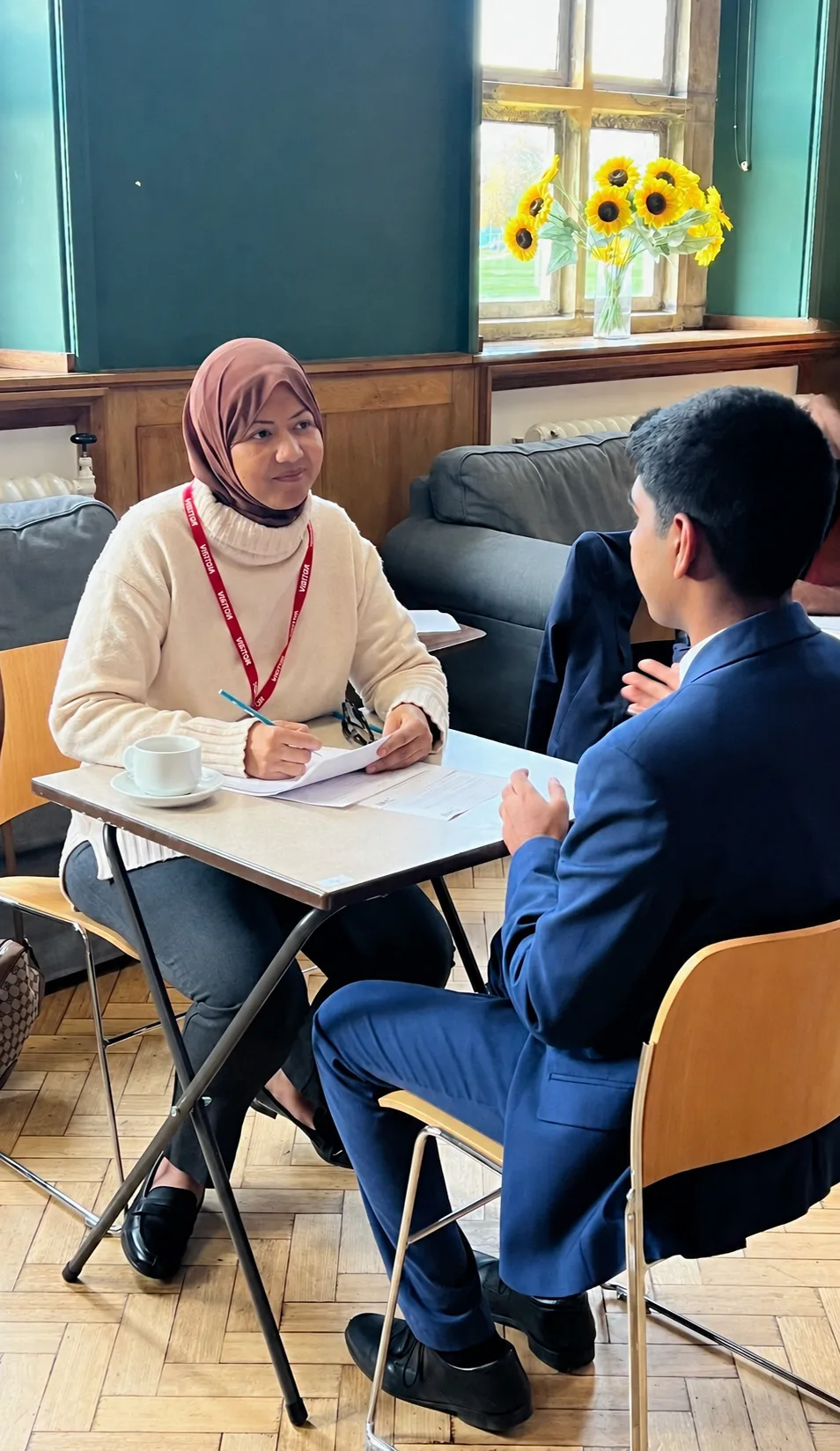
A dental school mock interview tests whether an applicant can apply what they have learned while another person is assessing them in real time. This is materially different from reading interview questions at home, where a student can pause, restart, look at notes or avoid difficult topics.

Realistic Dental Interview Practice

A university-specific 1-to-1 mock can be adapted to the relevant dental school’s current interview style and may include timed questions, panel-style discussion, MMI stations, dentistry-specific scenarios, role-play, ethical dilemmas and challenging follow-up questions. The aim is not to predict confidential interview questions; it is to reproduce the demands of interview performance: listening, interpreting, thinking, speaking and adapting under pressure.

Personalised Feedback

Feedback can identify strengths and development priorities in answer structure, communication, reasoning, professionalism, empathy, reflection, body language, timing and response to follow-up questions. Students can then focus their remaining preparation on the areas most likely to improve performance rather than repeatedly practising what they already do well.

Dental Panel Mock Interview

A dental panel mock interview is particularly useful for applicants preparing for a longer, conversational interview. It can recreate sustained follow-up across motivation, dental work experience, ethics, professionalism, NHS dentistry and personal reflection, while testing whether the applicant can maintain structure and composure throughout a longer discussion.

How Our Dental School Interview Preparation Works

Dr Admissions uses Dr Ahmed’s InterVIEW™ Method as a repeatable framework for both preparation and live interviews.

Step 1 — Interpret

Identify what the question or scenario is actually asking and which qualities are being assessed.

Step 2 — Voice

Give a direct, clearly structured answer with logical progression rather than relying on generic or memorised material.

Step 3 — Integrate

Support the response with relevant personal experience, reflection and appropriate dental, healthcare or ethical knowledge.

Step 4 — Evaluate

Assess the strength of the response against interview expectations and identify what worked and what needs improvement.

Step 5 — Work on Weaknesses

Use repeated questions, role-play, timed practice and personalised feedback to improve weaker areas.

The aim is to produce an applicant who can approach unfamiliar questions independently, not one who needs a pre-written answer for every possibility.

Who Is Our Dental School Interview Preparation Course For?

  • Dental applicants who have received an interview invitation
  • Students preparing before interview invitations arrive
  • Applicants facing their first dental school interview
  • Students preparing for MMI interviews
  • Applicants preparing for panel interviews
  • Students who find it difficult to structure answers or communicate confidently
  • Applicants wanting realistic university-specific mock interview experience
  • First-time applicants and reapplicants

Why Choose Dr Admissions for Dental Interview Preparation?

Led by an Experienced NHS Medical Consultant and Former Medical School Interviewer

Dr Ahmed’s interviewing and clinical teaching experience shapes an approach centred on what assessors are trying to evaluate: communication, reasoning, reflection, professionalism and judgement. Former-interviewer experience is not used to share confidential questions or protected university material.

Dentistry-Specific Preparation Built on Extensive Medical Interview Experience

Many core competencies assessed in medical and dental interviews overlap, including communication, empathy, ethics, teamwork, professionalism and patient-centred care. Dr Ahmed is a medical doctor rather than a dentist, and the programme is therefore adapted specifically for dental applicants through dentistry-focused motivation, work-experience reflection, dental awareness and appropriate professional scenarios.

Structured Preparation Rather Than Question Banks Alone

Students are taught transferable interview technique, not simply given more questions to memorise. The emphasis is on identifying what is being assessed, constructing an individual answer and responding naturally when the interviewer changes direction.

Realistic Mock Interviews and Individual Feedback

Applicants can combine teaching with university-specific mock interview practice to test their performance under pressure and receive targeted development points.

A Reported 2026 Qualifying-Cohort Result

For the 2026 entry cohort, every student who completed a Dr Admissions Interview Course and at least one Dr Admissions mock interview received at least one medical or dental school offer. This is a reported result for that qualifying cohort, not a guarantee of future admission.

Dentistry Interview Crash Course for Short-Notice Interviews

For applicants with sufficient preparation time, the full 11-week programme provides the greatest opportunity for repeated practice and refinement. A shorter crash-course option is intended for students whose interview is approaching quickly, who receive a short-notice invitation or who need focused last-minute preparation after preparing independently.

Focused preparation can prioritise interview format, answer structure, motivation, ethics, communication and timed MMI or panel practice, but it cannot recreate the benefits of sustained practice over several weeks. Dr Admissions Crash Courses are planned for December–January.

Ready to Prepare for Your Dental School Interview?

Build transferable interview skills first. Tailor them to the individual dental school second.

The 11-week Dr Admissions Dental School Interview Preparation Course combines consultant-led teaching, dentistry-focused MMI and panel preparation, the InterVIEW™ framework, live verbal practice and recordings. The first live session is free, allowing students to experience the teaching before committing to the programme.

FAQ

1. What does a Dental School Interview Preparation Course include?

A comprehensive course should cover interview technique as well as dentistry-specific content. Dr Admissions preparation includes MMI and panel technique, motivation for dentistry, work-experience reflection, communication, ethics, professionalism, dental awareness, structured verbal practice and access to university-specific mock interviews.

2. How should I prepare for a dental school interview?

Start by confirming the interview format used by the dental school. Build strong foundations in motivation, work-experience reflection, ethics, communication and dental awareness, then practise those skills aloud under timed conditions. Preparation should make you more adaptable, not more scripted.

3. What is the difference between a dental MMI and a panel interview?

A dental MMI usually consists of several shorter stations, each assessing a particular competency or scenario. A panel interview is generally a longer discussion with several interviewers and may involve sustained follow-up questioning across multiple themes.

4. What happens during a dental school mock interview?

A mock interview gives the applicant realistic verbal practice adapted to the relevant interview style. It can include timed questions, panel discussion, MMI-style stations, role-play, ethics and follow-up questioning, followed by personalised feedback on performance and priorities for improvement.

5. How can I prepare for a dental panel interview?

Practise longer answers and follow-up discussions rather than individual questions alone. Be prepared to justify motivation, reflect on work experience, discuss professional and ethical issues, explain your reasoning and remain composed when interviewers probe your answer.

6. What questions are asked in dental school interviews?

Themes commonly include motivation for dentistry, work experience, communication, ethics, professionalism, teamwork, patient-centred care, dental awareness, problem-solving, reflection and reasons for choosing a particular university. Questions may also be presented as scenarios rather than direct prompts.

7. Can I take a dentistry interview crash course before my interview?

Yes. Focused last-minute preparation can help identify high-impact weaknesses when time is limited. Where there is sufficient preparation time, the full programme allows more opportunity for repeated practice, feedback and refinement.

8. How can Dr Admissions help with dental school interview preparation?

Dr Admissions provides consultant-led, dentistry-focused preparation for MMI and panel interviews, structured interview frameworks, live verbal practice and the option of a university-specific dental school mock interview with personalised feedback.

    Book Courses

      Book A Free Consultation

      UCAT Courses 2026

      UCAT 2026 Courses

      2025 students scored 2650 and 2620

      View UCAT courses