







UCAT Practice Tests & Question Bank - Dr Admissions

UCAT Question Bank & Mock Exam

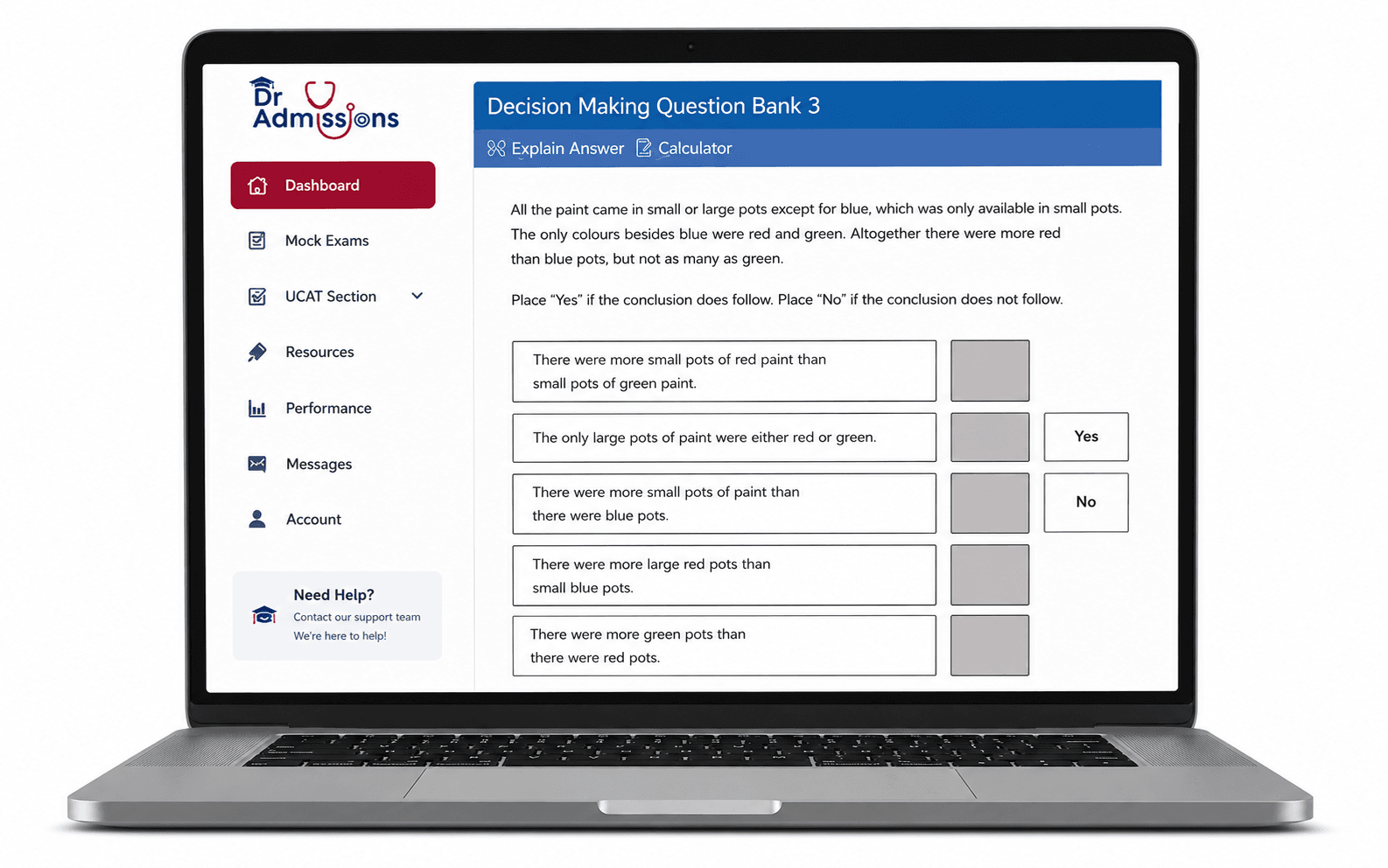
Practise on a realistic UCAT-style platform


Access UCAT question banks, a full mock paper, simulated tools, and a realistic test interface designed to mirror the real UCAT portal. Built by top 1% UCAT scorers and NHS consultants to help you prepare with accuracy, speed, and confidence.

Start UCAT Practice

Practice All UCAT Sections

Our preparation material covers all core sections of the UCAT exam in depth:

Verbal Reasoning – Develop critical reading and analytical thinking skills

Read More

Decision Making – Strengthen logical reasoning and data interpretation

Read More

Quantitative Reasoning – Improve numerical problem-solving under time pressure

Read More

Situational Judgement – Learn how to approach professional and ethical scenarios

Read More

Each section is carefully designed to help students understand question patterns, master time management, and build confidence.

Introduction

The UCAT (University Clinical Aptitude Test) is the sole medical school admissions test used in the UK. Although different medical schools utilise candidates’ UCAT score differently in their applicant selection process, it is, for the vast majority of universities, a critical decider for handing out interviews and offers

Success in the UCAT requires consistent, structured practice that improves speed and accuracy under timed conditions. This is essential to mirror, as close as possible, the real exam experience, which is paramount to scoring highly in such a time-pressured and stressful examination. 

The UCAT official websitehas a selection of practice questions constituting the Question Banks, as well as 4 Practice Tests which are free and designed to be representative of the real test. However, these resources are limited, so Dr Admissions Portal provides additional practice questions with realistic exam simulations accompanied by performance analytics that help track your improvement for optimal structured revision.

Why UCAT Practice Matters

Unlike traditional academic exams, the UCAT tests how quickly and accurately students can process information under strict time pressure. Therefore, regular exposure to UCAT practice questions and realistic UCAT mock texts allows students to develop the proper exam techniques and timing strategies needed to achieve a competitive score.

Consistent UCAT practice ensures candidates become familiar with the structure and style of the exam. The UCAT involves multiple timed subsets, which can, for many students, feel initially overwhelming. By completing practice questions regularly, students become more comfortable with the layout of each UCAT section, the common question types and wording, and time allotment. This familiarity reduces uncertainty on the actual exam day, allowing students to focus on the question contents rather than adjusting to the unfamiliar test structure and environment.

The UCAT challenges the student to balance speed and precision. If given unlimited time, students could easily score close to full marks on the UCAT. It is the difficulty of solving questions through spotting “short cuts” in a method that makes the UCAT so tough. Therefore, practising under timed conditions is essential to avoid building up bad habits. Students often opt for using a longer method to solve a question if practising under untimed conditions, rather than building up the skills necessary to spot shortcuts. Practice under timed conditions allows students to find strategies that save time where possible, whilst retaining high accuracy.

Every student performs differently across the UCAT subtests. Regular practice allows a student to identify which sections they consistently perform better or worse in, as well as any specific questions that pose difficulty, so that revision time can be better allocated to their weaker areas. This targeted approach leads to more efficient revision and faster score improvement than revising every section equally.

Confidence is a major contributor to scoring high in the UCAT. Students who are more prepared are more likely to stay calm under pressure meaning they manage difficult questions more effectively and navigate the overall test better. Taking full-length UCAT mock tests help students simulate real exam conditions and develop the mental stamina needed for the actual UCAT.

Download a Free UCAT Log Book

UCAT Practice Tests vs Question Banks

A full UCAT mock test refers to a practice exam designed to replicate the real UCAT as closely as possible. It features the same question types in the same structure of the same difficulty. Although it obviously won’t exactly replicate the test on the exam day, it is engineered to mimic it as closely as possible. Rather than focusing on individual skills, mock tests provide a complete picture of a student’s readiness for the exam. 

A UCAT question bank is a collection of practice questions organised by section, topic or question type. Unlike a full mock test, a question bank allows students to focus on specific areas of the exam that they are struggling with, and practice them repeatedly. 

Both resources have an equally important role in UCAT preparation, but serve different purposes. Question banks are typically most useful during the earlier periods of preparation, where students are still learning how different question types work and still developing the techniques needed to answer them effectively. Mock tests increase in importance the closer to the exam, once students have already built a strong foundation through targeted practice, these full-length tests provide the platform to apply those skills under realistic conditions and assess overall readiness. 

This is not to say that question banks should be used exclusively in early practice and mock exams should only be used in the lead up to exams. In fact, it is advisable to start with a “baseline full mock test”, before any practice, to set a benchmark to view how a student is progressing over time, and assess if revision is effective. Mock tests should be repeated relatively regularly, with increasing frequency closer towards a candidate’s test date. Question bank practice should be used more widely, in the beginning, to learn the different approaches to tackling various question types. Closer to the test date, practice questions should be used in a targeted manner, practicing areas the student is weaker in, and not dropped entirely in favour of mock exams.

Explore UCAT Practice by Section

The 2026 UCAT consists of 4 sections, which are separately timed and all in a multiple-choice format

Verbal reasoning (VR) assesses a student’s ability to critically evaluate written information

Decision making (DM) assesses a student’s ability to make decisions and judgements when faced with complex logical problems

Quantitative reasoning (QR) assesses a student’s ability to solve numerical problems

Situational judgement (SJT) measures a student’s capacity to apply ethics and identify appropriate behaviours in real world situations

VR, DM, QR are scored between 300 – 900 each, whilst the SJT is assigned band 1 – 4 (with 1 being the highest).

SubtestQuestionsInstruction sectionUCAT Subtest TimeScoring
Verbal Reasoning441 minute 30 seconds22 minutes300 – 900
Decision Making351 minute 30 seconds37 minutes300 – 900
Quantitative Reasoning362 minutes26 minutes300 – 900
Situational Judgement691 minute 30 seconds26 minutesBands 1 – 4

UCAT Verbal Reasoning

VR assesses a student’s ability to read, interpret, and evaluate written information quickly and accurately. Many candidates find this section particularly difficult due to the large volumes of text. 

Regular VR practice improves students’ ability to extract key information from passages, identify relevant evidence, and answer questions efficiently. In particular, time VR mock prep is important to build the ability to scan for keywords, develop active reading techniques, and draw best answer conclusions.

UCAT Decision Making

DM assesses a student’s ability to analyse information, recognise patterns, evaluate arguments and draw logical conclusions. Success in DM depends on understanding logic and applying it to sometimes unusually worded scenarios. 

There are distinct question types within the DM section, to which specific strategies can and should be developed, and tried out in practice.

UCAT Quantitative Reasoning

QR assesses numerical problem-solving skills using charts, graphs, tables, percentages, ratios, and basic arithmetic calculations. The maths involved is largely straight forward, below a GCSE maths level; the difficulty in QR comes from the strict time pressure. 

Again, regular QR practice is needed to identify short cuts, and develop mental arithmetic skills to decrease reliance on the on-screen calculator which is slow to operate in the exam.

UCAT Situational Judgement

SJT assesses how candidates respond to scenarios commonly encountered in healthcare, education and professional environments. Rather than testing academic knowledge, this section evaluates judgement, professionalism, ethics and interpersonal skills

Preparation should focus on understanding the values expected of future healthcare professionals, including integrity, teamwork, candour, confidentiality, prioritising patient safety. Students should practice SJT questions to improve their performance by reviewing common dilemmas and what the most appropriate answer is given contextualising information.

Free UCAT Practice Test Options

There are various free resources online in both the form of mock tests and question banks. An important resource is the UCAT official website which has a selection of practice questions constituting the Question Banks, as well as 4 Practice Mock Tests. This limited resource is insufficient by itself in terms of amount of practice, so must be supplemented by other free practice UCAT tests to ensure that students have had enough practice to develop accurate and efficient strategies to tackle different sections and question types. Dr Admissions provides free extra practice questions, realistic exam simulations, and performance tracking to support structured, targeted revision.

How to Use a Question Bank Effectively

In the beginning of practice, it is best to evenly distribute your revision time between practice questions of the different sections. Depending on how much time you are allocating to revision, a daily practice plan may involve 2 hours of revision per section per day, or slightly more or less time allocated. Quickly, however, you will find that you are better at, or progressing faster in, certain sections, which you can ascertain through doing a “baseline mock test” followed by infrequent mock tests in the early stages. For example, if you are consistently scoring band 1 in SJT, you may want to shorten to only 30 minutes per day of practice, and redistribute the rest of this time to areas in which you are struggling. It is also important after the early stages, to identify your weaker question types within a section through error tracking, so that even within a per section revision time, more time is allocated to practicing and developing more efficient strategies for question types that you struggle with. This is the basis of topic-wise revision. Within each section in some UCAT question banks, there are more difficult and simpler questions, and you may want to start on easier problems and progress in difficulty, to develop solid foundations to tackle easier questions of the same type, before developing further skills to handle harder problems.

2026 UCAT Revision Strategy

Here is an example of an 2026 UCAT revision timeline. Remember this is an example, not one that you have to follow to score highly, but the general time splits have worked for past students who have done well. 

Before starting any practice, it is advisable to complete an initial baseline mock test, a good one to do is the official UCAT mock test A, and use a score converter to provide a rough estimate of your starting UCAT score. This will be used as a benchmark to track progress through mock exams going forwards. 

Then work on at least a week of time practice questions to develop strategies and understand the different question subtypes before completing your next mock, to assess your progress. 

From here, you will have an understanding of your stronger and weaker sections, allowing you to dedicate more practice time to your struggling areas. 

Continue with weaker section-specific/dominant practice, accompanied by biweekly mock tests, until 3 – 4 weeks out from test date, and increase to daily mock tests.

Download Dr Admissions Free UCAT Planner

Why Choose Dr Admissions for UCAT Preparation

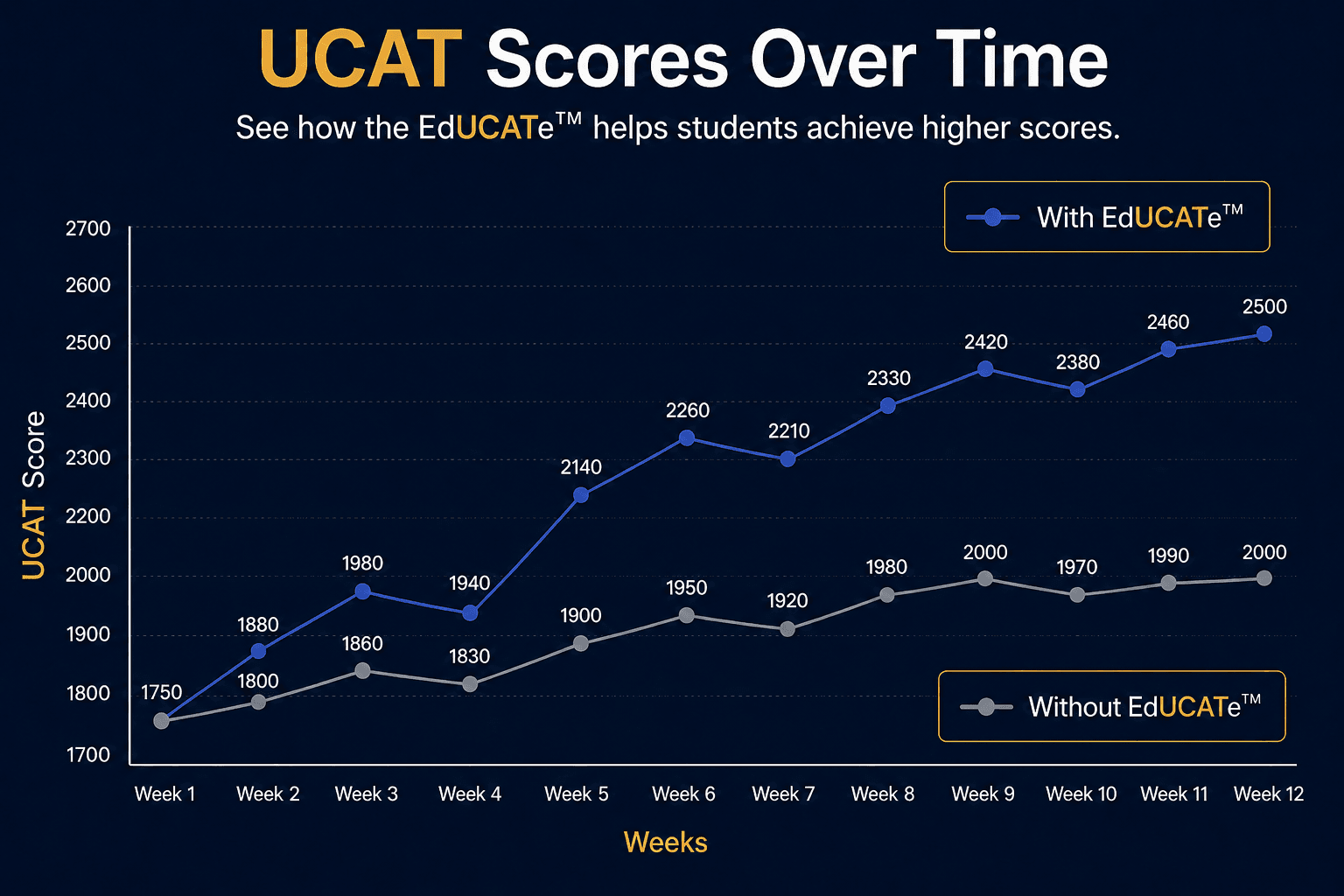
Choose Dr Admissions for a Consultant-Led medical and dental admissions support that is structured, personalised and results-focused. Our unique EdUCATe™ method goes beyond generic tutoring by helping students Evaluate their strengths and weaknesses, Design a targeted study plan, Understand key techniques, Consolidate learning through focused practice, Apply skills under timed conditions, and Transform performance through data-led refinement. 

This unique preparation is not just about doing more questions, but about improving accuracy, timing, decision-making and confidence across all sections with expert mentoring. Further support is given with mock exam guidance with personalised support.

Download the UCAT Course Curriculum.

FAQ

What is the best UCAT practice test for 2026?

The official UCAT mocks, made by the board, are most representative of the question style in the real exams, and are what other resources are based on. Dr Admissions Mock Papers are extra resource and mirrored on this style.

Is there a free UCAT practice test available?

There are free practice tests on the official UCAT website, as well as Dr Admissions portal.

How many UCAT mock tests should I complete?

Ideally as many as possible! However, it is much more important to properly review each mock and analyse your faults, rather than simply doing lots of mocks

What is a UCAT question bank?

A UCAT question bank is a collection of practice questions organised by section, topic or question type

Are UCAT practice questions similar to the real exam?

The practice questions are similar in style to the real exam. Although the difficulty may not be exactly the same across all questions, it is rather representative!

    Book Courses

      Book A Free Consultation

      Year 12

      UCAT 2026 Preparation

      Sign up now for ucat 2026 packages and start focus preparation.

      Early Bird Discount

      View UCAT courses