








Explore UCAT Practice by Section
The 2026 UCAT consists of 4 sections, which are separately timed and all in a multiple-choice format.
Verbal reasoning (VR) assesses a student’s ability to critically evaluate written information.
Decision making (DM) assesses a student’s ability to make decisions and judgements when faced with complex logical problems.
Quantitative reasoning (QR) assesses a student’s ability to solve numerical problems.
Situational judgement (SJT) measures a student’s capacity to apply ethics and identify appropriate behaviours in real world situations.
VR, DM, QR are scored between 300 – 900 each, whilst the SJT is assigned band 1 – 4 (with 1 being the highest).
| Subtest | Questions | Instruction section | UCAT Subtest Time | Scoring |
| Verbal Reasoning | 44 | 1 minute 30 seconds | 22 minutes | 300 – 900 |
| Decision Making | 35 | 1 minute 30 seconds | 37 minutes | 300 – 900 |
| Quantitative Reasoning | 36 | 2 minutes | 26 minutes | 300 – 900 |
| Situational Judgement | 69 | 1 minute 30 seconds | 26 minutes | Bands 1 – 4 |
UCAT Verbal Reasoning
VR assesses a student’s ability to read, interpret, and evaluate written information quickly and accurately. Many candidates find this section particularly difficult due to the large volumes of text.
Regular VR practice improves students’ ability to extract key information from passages, identify relevant evidence, and answer questions efficiently. In particular, time VR mock prep is important to build the ability to scan for keywords, develop active reading techniques, and draw best answer conclusions.
UCAT Decision Making
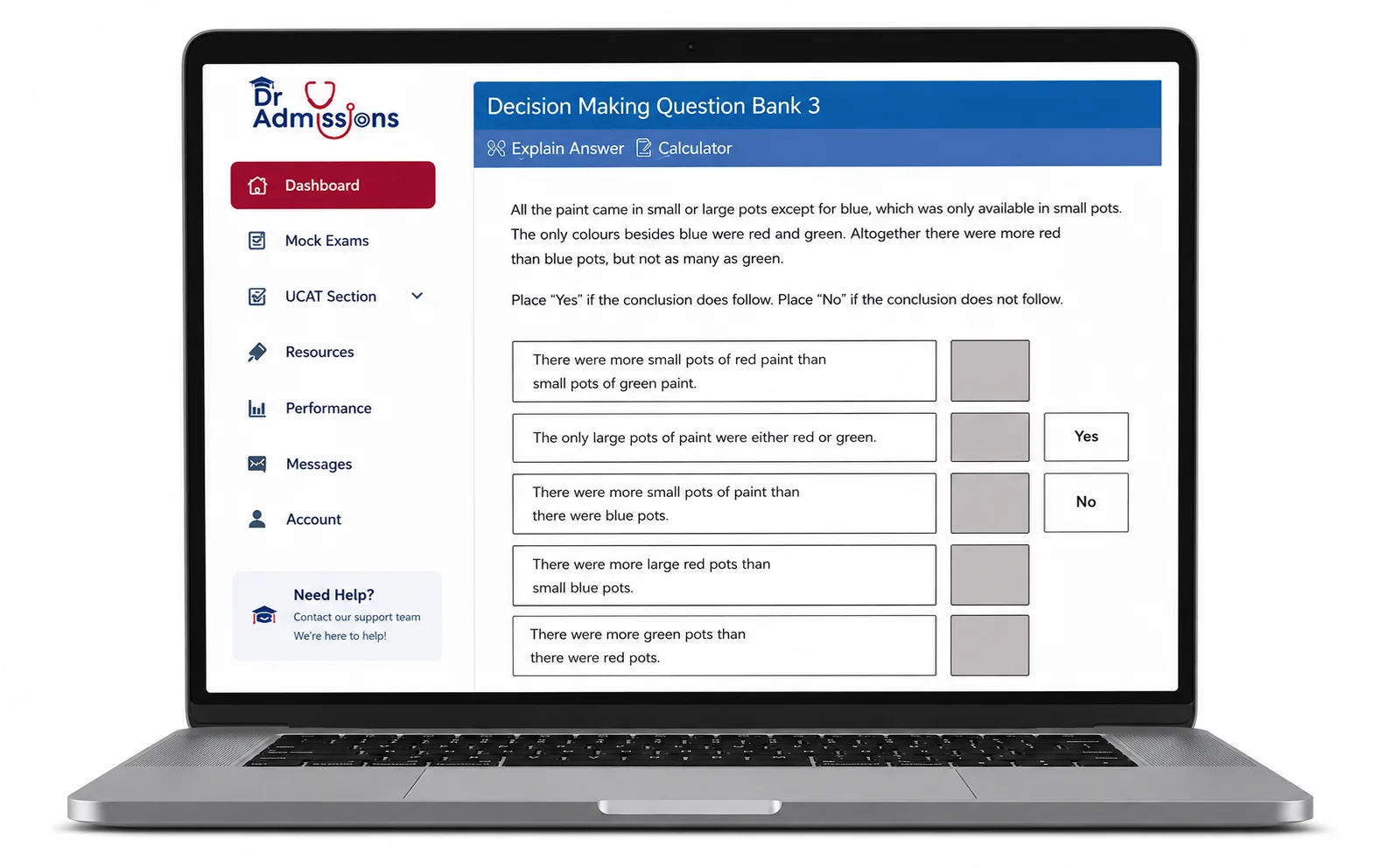
DM assesses a student’s ability to analyse information, recognise patterns, evaluate arguments and draw logical conclusions. Success in DM depends on understanding logic and applying it to sometimes unusually worded scenarios.
There are distinct question types within the DM section, to which specific strategies can and should be developed, and tried out in practice.
UCAT Quantitative Reasoning
QR assesses numerical problem-solving skills using charts, graphs, tables, percentages, ratios, and basic arithmetic calculations. The maths involved is largely straight forward, below a GCSE maths level; the difficulty in QR comes from the strict time pressure.
Again, regular QR practice is needed to identify short cuts, and develop mental arithmetic skills to decrease reliance on the on-screen calculator which is slow to operate in the exam.
UCAT Situational Judgement
SJT assesses how candidates respond to scenarios commonly encountered in healthcare, education and professional environments. Rather than testing academic knowledge, this section evaluates judgement, professionalism, ethics and interpersonal skills.
Preparation should focus on understanding the values expected of future healthcare professionals, including integrity, teamwork, candour, confidentiality, prioritising patient safety. Students should practice SJT questions to improve their performance by reviewing common dilemmas and what the most appropriate answer is given contextualising information.